
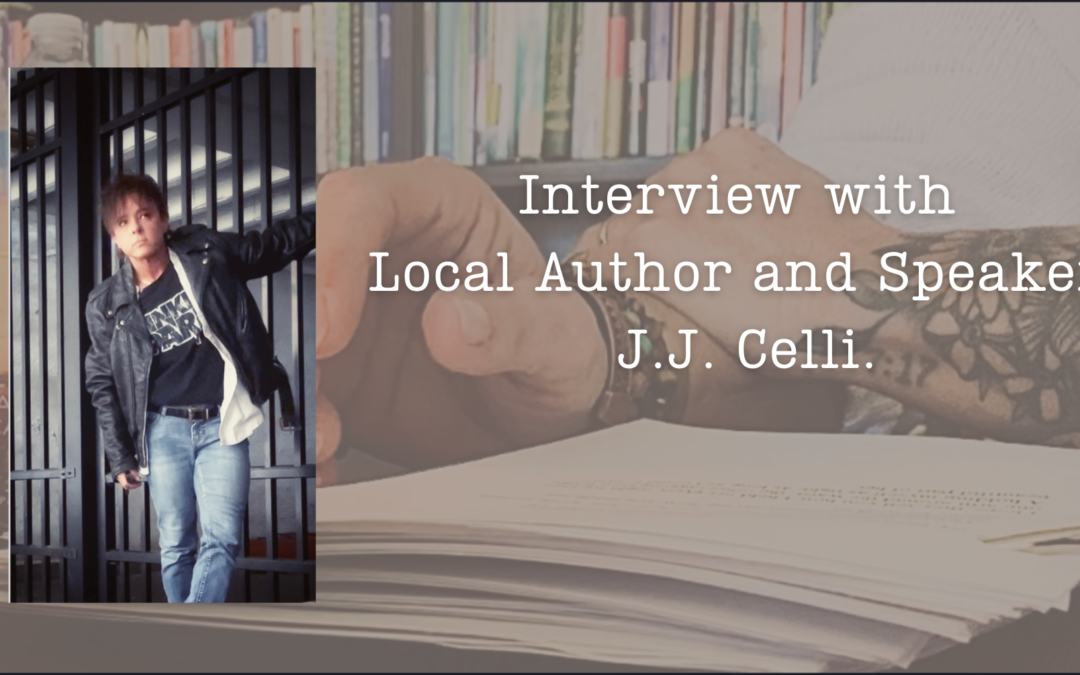
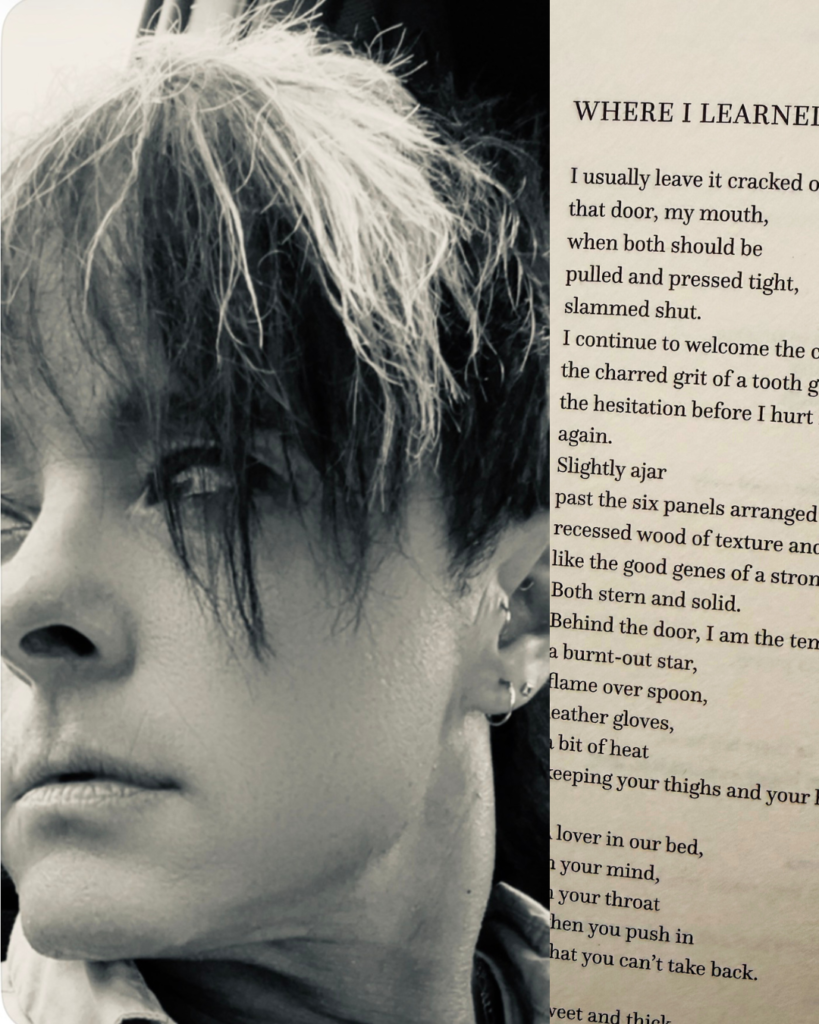
J.J. Celli is a queer writer from the Chicago area, where she is active in the spoken word poetry scene. Celli spent over two decades fighting crime and working as a major crimes/homicide detective, later retiring as a Sergeant. As a survivor of intimate partner gun violence, she is passionate and dedicated to educating others on domestic violence in same-sex relationships, while also advocating for the LGBTQ community.
J.J. was kind enough to answer some of our questions, and we’re so excited to share those with you.
Name an author or a book that influences you and why.
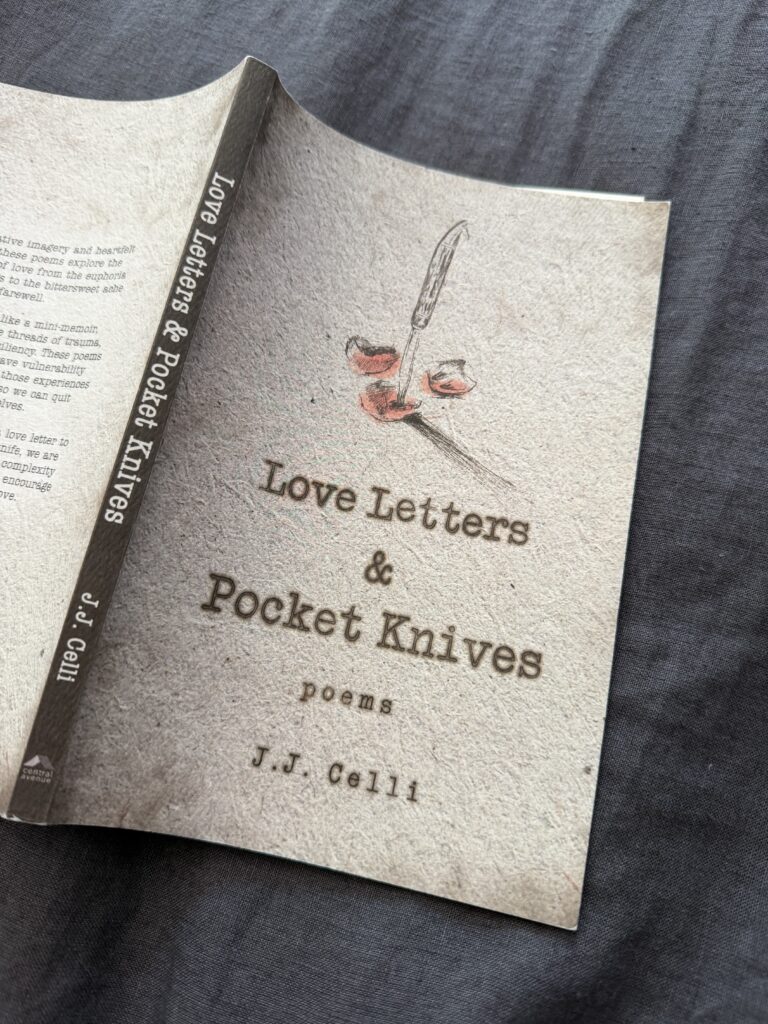
I love the grit, melodramatic form and cadence of poet Jeanann Verlee. She is not only one of my favorite writers, but I read or listen to her work when I want to be inspired, or just jacked up with raw, artist energy! I adore all three of her poetry collections (Racing Hummingbirds, Said The Manic To The Muse and Prey). I was extremely fortunate to have the opportunity to have her read and critique Love Letters & Pocket Knives midway through my submissions journey. Her opinion really made me think about style and the space my language was owning on the page.
Describe your writing process.
I write daily, but not always with a specific purpose in mind. A lot of the time, what I’m writing isn’t for inclusion into something I’m working on. Sometimes it takes weeks or even months before I realize something I wrote is of interest to share. I carry a notebook with me everywhere and have for decades. I write things down when I overhear a phrase that catches me, or when a feeling/thought moves through me, and I don’t want to lose it.
My physical writing process is pretty analog. I write everything by hand and across different notebooks. Ink and paper feel the most honest and true to what I’m thinking and expressing. Later, I’ll flip through old pages and realize two completely separate pieces are actually speaking to each other, like they belonged together the whole time. I’m not a big fan of typing, I am not very technically savvy either, and all that feels lot like being at work.
Describe your writing style in one word.
Confessional.
How did you discover that you were a writer?
I think I discovered I was a writer when I stopped focusing on what I do and paid attention to how I am. We often define ourselves by titles or professions, but writing never felt like a career choice; it still doesn’t, it’s more like a state of being. I write because I observe deeply. I write because I sit with things longer than most people probably want to. That’s a blessing and a curse.
Tell us something about your work that a reader wouldn’t expect.
One might not expect this, but I’m fascinated by neuroscience: the wiring, the chemistry, the chaos and control of the human brain. I have a MA in Forensic Psychology, so I spent many years learning and understanding the human condition. I know science probably sounds worlds apart from poetry, but to me, it’s not. I get as much joy flipping through my old psychology textbooks or rereading the DSM-IV as I do reading poems. Understanding the ‘why’ behind our thoughts and behaviors adds a whole other layer to how I write about love, trauma, healing, and everything in between. It’s like decoding the poetry of the mind before translating it onto the page.
What was the inspiration behind your book?
My love life. There’s a little bit of every lover I have ever had in this collection.
Are your characters based on real people or entirely fictional?
The characters, places, and scenes are all autobiographical.
Which philosophy or philosopher most aligns with your own beliefs?
I don’t align myself strictly with one philosopher, but I gravitate toward existential and humanistic thought because I do believe that meaning is constructed through experience, responsibility, and awareness. I think writing itself is a philosophical act. It’s an insistence that experience matters enough to be examined and understood. At the same time, I align in many ways with Stoic philosophy, particularly the distinction between what we can control and what we can’t. As a writer, that translates into responsibility. I may not control what has happened in my life, but I do have agency in how I interpret it, hold it, and shape it into language. For me, philosophy and writing intersect in that space… in the conscious act of turning lived experience into meaning.
Have any readers interpreted your work differently than you intended?
Yes, absolutely, and I welcome that. I think many readers interpret poetry differently than the writer may have originally intended, and that’s part of what makes poetry powerful, after all, isn’t it supposed to be porous? There’s often intentional ambiguity in my work because I don’t want to control the reader’s experience. I want to create space for them to enter the poem with their own history, their own wounds, their own joy. If someone reads something differently than I intended, that tells me the poem is alive.
What part of the writing process do you find most challenging—or most rewarding?
The most challenging is revision. I get completely tied up in editing—line breaks, punctuation, small details—especially when it comes to poetry. I’ve even edited poems so much that they become strangers to me, and I can’t even say I know them anymore.
Ultimately, a poem, or a chapter to me, is finished when it stops demanding anything from me, when the urgency has passed, and the emotion, memory, or impulse that drove it has run its course. After that, it exists on its own, separate from me, and I try to leave it be. Editing always feels heavy and overwhelming to me. I think I am better at chasing the animal than finding ways to cage it to the page.
Bless the editors!!
What do you find most surprising about being a published author?
Nothing changes.
What’s the best writing advice you’ve ever received—or like to give?
The advice I would give…write before you start hating what you’ve written. Don’t wait to feel ready, inspired, or for the perfect word. There isn’t one. Write what’s hard and write what makes you uncomfortable. That’s usually the real stuff. Let it be messy and too much. Let it come from wherever it wants. Writing isn’t about sounding smart anyway.
Pay attention to the music inside a line, and don’t be afraid of silence either. If you sit still long enough, something honest will crawl out. Remember, your voice is Art, and it matters. Don’t worry about rules; you can learn those later.
What are you working on now?
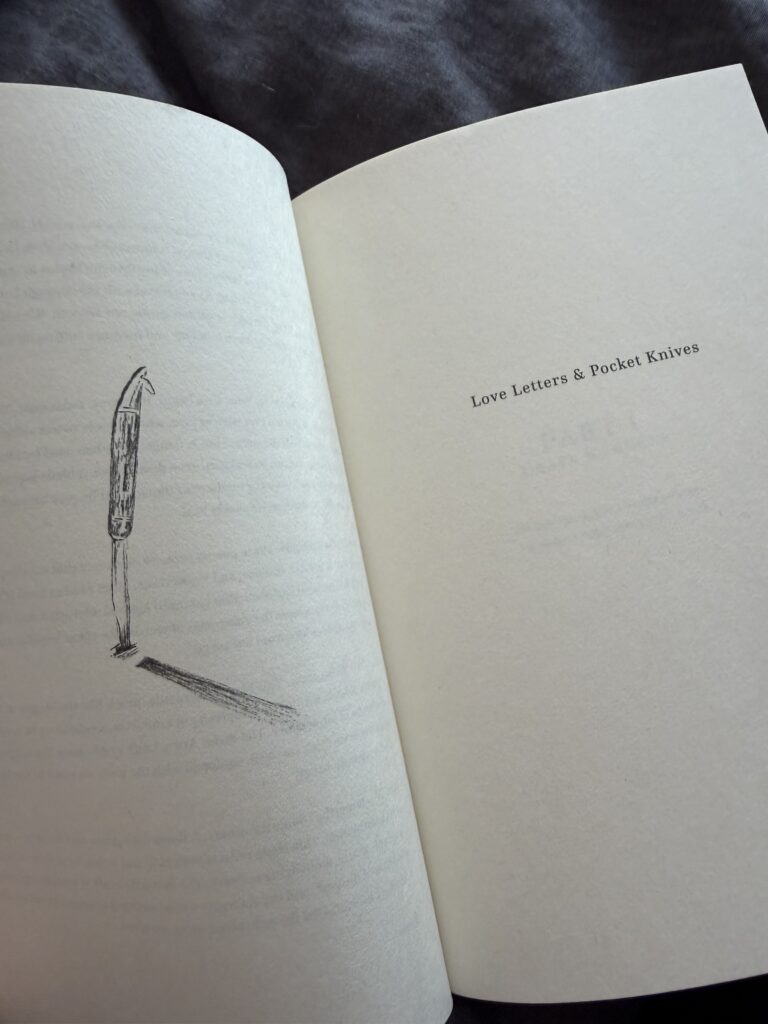
I recently completed the draft for Part II of Love Letters & Pocket Knives. I have always felt this collection was part of a larger series and I’m intrigued by where it’s going. At the same time, I am working through a memoir based on my personal experiences of being shot by an ex-girlfriend and the betrayal and injustice I felt by a criminal justice system I dedicated myself and over two decades to serving. It’s deeply personal, and probably the hardest thing I’ve ever written, but it’s a story that needs to be told.
Describe your ideal reader.
I don’t have an MFA, and I don’t know all the “rules.” I’m messy. I’m imperfect and so is my writing. I wrestle with imposter syndrome almost every time I sit down to write. Some days I feel like I’m barely keeping the words alive, and yet I keep showing up anyway. That struggle, and persistence is part of my work. Whether it’s poetry or my memoir I’m working on, it’s all very personal. It comes from lived experience, from the pain, and the joy of my life. I write to witness, understand, and to share the unvarnished truth.
Because of that, my ideal reader is someone who doesn’t need comfort. Someone who can sit with a little mess, and a little truth they weren’t expecting. They don’t have to like what I am even saying, but feeling it would be great. My ideal reader is somebody who sees themselves in the chaos, or at least isn’t afraid to. Someone willing to lean into discomfort and to recognize their own humanity in mine.
Please recommend a local author you love and why.
John Justin McCarthy’s poetry collection Scared Violent Like Horses is an incredible telling of self, masculinity, and the Midwest. It’s hard, honest, and emotionally resonant. Every time I read this book, I discover something new about the author, about myself, and about the landscape that has shaped us both.
You can find Love Letters & Pocket Knives here in our Local Author Directory!
Want more? Subscribe to J.J.’s newsletter: jjcelli.com! Follow J.J. on instagram @j.j.celli!
About Us
The Republic of Letters serves Illinois Fox Valley area: including the communities of Saint Charles, Geneva, Batavia, Aurora, Wheaton, Elburn, and beyond.
Get In Touch
info@rolreadlocal.com
(630) 567-5410
©The Republic of Letters 2025